










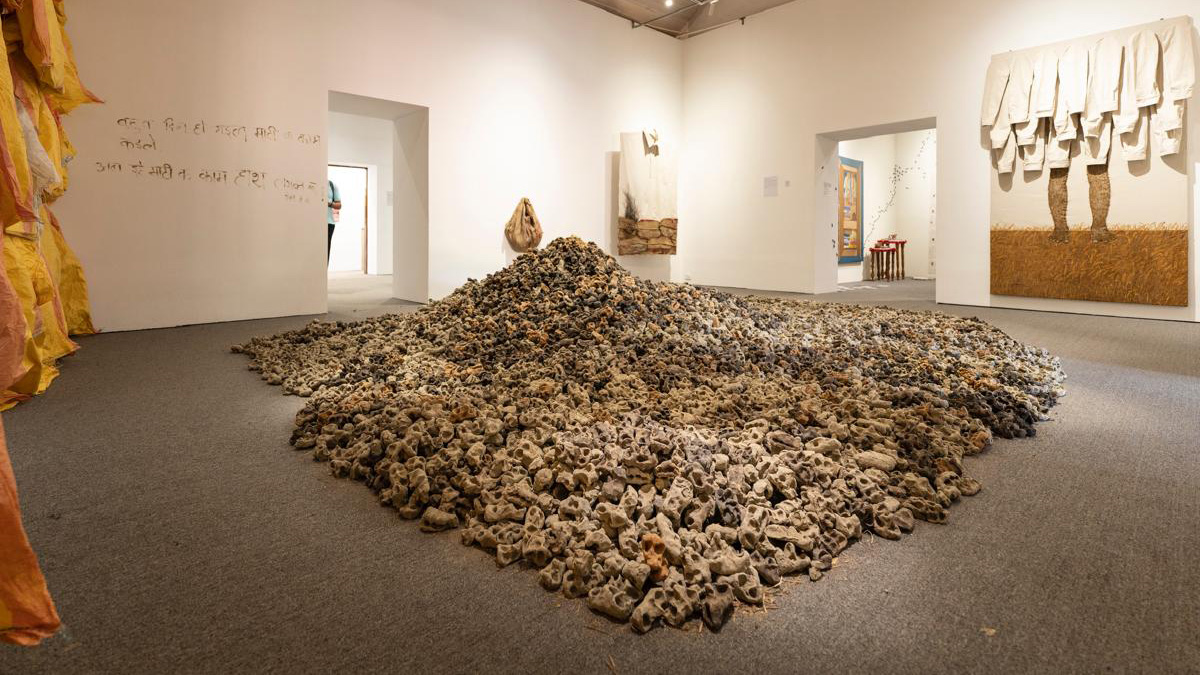
At the Arthshila venue of the Students’ Biennale 2025 in Kerala’s Cochin, a textile work draws visitors in not through spectacle, but through quiet persistence. Inheritance of the Hand, a collaboration between artists Mohammad Riyaz and Aman Kumar, uses painted and stitched muslin to trace stories of labour, memory, and lived rural experience.
Riyaz, who hails from Gwalior in Madhya Pradesh, completed his Master of Fine Arts at the Government College of Fine Arts, Gwalior. His artistic practice is deeply rooted in his upbringing in a farming environment, shaped by years of witnessing the uncertainties and hardships that define agrarian life in India.
“The central focus of my work is the Indian farmer,” Riyaz says, whose current exhibits are part of the Students’ Biennale.

Growing up, he saw repeated crop losses caused by unpredictable rain and accidental fires, followed by long and often futile visits to government offices in search of compensation. These moments of loss and bureaucratic exhaustion left a lasting imprint.
“These experiences stayed with me and became questions I wanted to work through,” he says.
In Inheritance of the Hand, Riyaz employs tailoring techniques to stitch together painted muslin—an evocative choice, given the fabric’s historical ties to India’s colonial past. The work’s most striking elements are stitched sleeves shaped like hands, assembled into a layered composition. They gesture toward labour, endurance, and the physicality of farming, while also reflecting the dignity and invisible burden carried by rural communities across generations.
Completed in Gwalior over the course of a month, the artwork posed significant technical challenges.
“Handling the sewing machine and fixing the many sleeves was challenging,” he says. “But conceptually, it came from my own life, so that part felt clear.”
The collaboration brings together distinct but complementary practices. Aman Kumar contributes through weaving and painting on muslin, drawing from memories and stories passed down by his grandmother. His focus on generational loss and inheritance adds another layer to the work, allowing two personal histories to intersect within a shared visual language.
At Arthshila, visitors have been spending time engaging with the piece. Riyaz notes that the response has been encouraging, with many viewers approaching him to ask questions and reflect on the themes embedded in the work.
Reflecting on his participation, Riyaz describes the Students’ Biennale as a significant moment in his artistic journey. He also expresses gratitude to the Kochi Biennale Foundation and the curatorial teams for placing trust in his work and providing it space to be seen.
The Students’ Biennale is one of the Kochi Biennale Foundation’s key educational initiatives, designed to support young artists from public institutions across India. The 2025–26 edition opened on 13 December 2025 and is running parallel to the sixth edition of the Kochi-Muziris Biennale.
Led by curators and collectives, the programme mentors students from over 150 institutions across seven regions of the country. These mentors engage closely with participants, shortlist works, and collaborate with selected students to develop projects for exhibition in Kochi—offering emerging artists a rare opportunity to present their work to a national and global audience.
Author