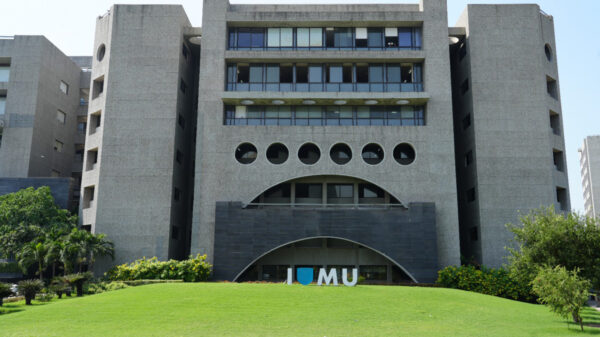













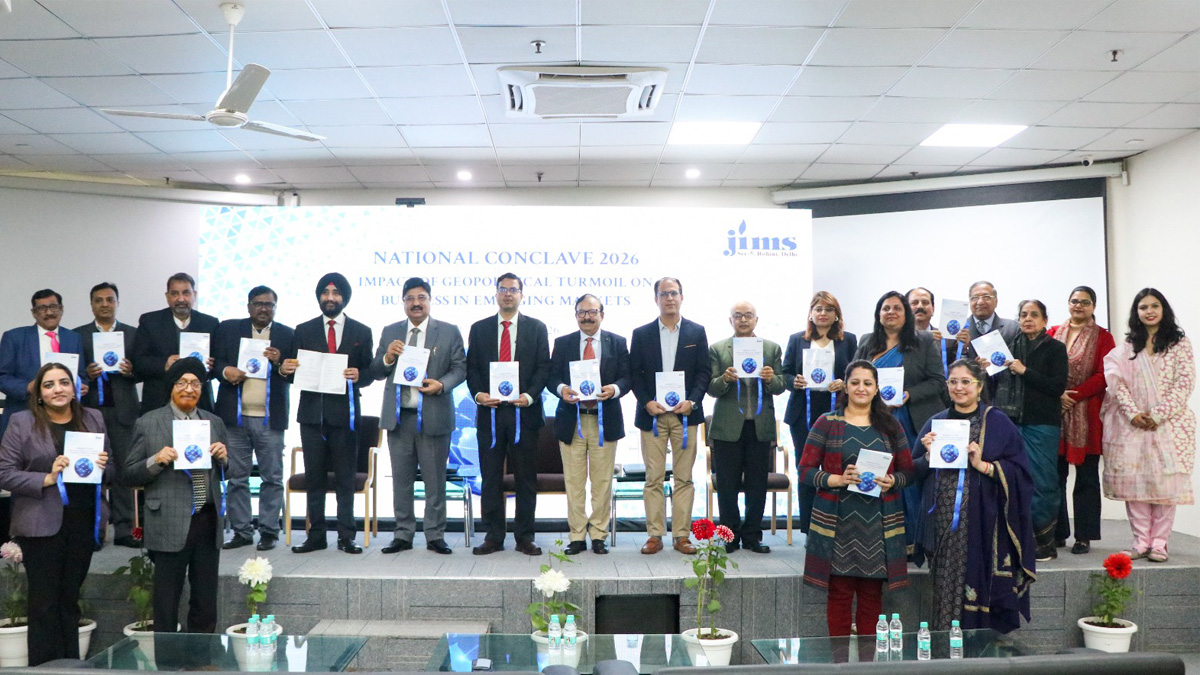
Jagan Institute of Management Studies (JIMS) Rohini hosted the National IB Conclave 2026, bringing together policymakers, industry leaders, academicians, researchers, and students to examine the impact of geopolitical turmoil on business in emerging markets. The one-day conclave was organised by the PGDM–International Business Department and focused on how trade shifts, conflicts, sanctions, and evolving global alliances are reshaping business paradigms.
The inaugural session set the tone by outlining the contours of a new global order and its implications for India’s positioning in world trade, finance, and energy—areas that are central to emerging-market economies. Speakers highlighted sectoral vulnerabilities alongside opportunity areas likely to gain from realignments in global supply chains and capital flows.
Delivering the keynote address, Ashok Bhagat, dean – corporate relations and placements at JIMS Rohini, underscored the growing relevance of geopolitical developments in the contemporary business environment and their direct bearing on the Indian economy.


Sonia Dhir, programme head, Department of International Business at JIMS Rohini, emphasised the importance of beyond-classroom learning through expert-led forums. She also pointed to recent Government of India reforms in 2025 and discussed how these could shape Indian firms’ responses to future geopolitical challenges.
The first panel discussion, “Business Under Impact – Quantifying Challenges from Geopolitical Turmoil in Emerging Markets,” translated uncertainty into economic realities, examining trade disruptions, commodity price volatility, capital-flow risks, supply-chain restructuring, and rising operating costs. Panelists called for diversification of export destinations beyond traditional markets such as the United States, improvements in product quality to enhance global competitiveness, and the need for ease-of-doing-business reforms to move from policy to practice. Comparisons were drawn with China’s manufacturing scale and state-supported infrastructure for the secondary sector.
The second panel, “India’s Way Forward – Strategic Responses to Geopolitical Turmoil,” focused on preparedness through trade diversification, diplomatic outreach, energy and technology partnerships, and regional cooperation agreements. Discussions highlighted addressing balance-of-payments pressures via export–import diversification, strategic use of free trade agreements, promotion of local-currency trade, energy portfolio diversification, and strengthening domestic financial instruments. Growth opportunities were identified in fintech, digitisation, clean and green energy, electric vehicles, defence manufacturing, and semiconductors—supported by infrastructure upgrades and India’s manpower advantage.
The sessions featured speakers including Ashminder Singh Bahal (founder, Bahal Associates; air commodore, Indian Air Force), Pravin Kumar (deputy general manager, Reserve Bank of India), Rahul Kashyap (group executive director, PRP Group), Rajeev Bansal (CEO, Celestial Lifestyle Ltd; vice-president, Indian Industries Association), Kavita Sirothia (general manager – international business, Indogulf Cropsciences Ltd), Atish Yadav (head – international business, Del Monte Foods Pvt Ltd), Nishit Kumar Sood (CEO, BYLD Group), Ratan Sehgal (managing director, Hybon Elevators & Escalators), Japneet Singh Sethi (chief growth officer – Asia, iGaming; alumni PGDM-IB 2013–15), Ashish Jain (deputy director general and regional head – north, Federation of Indian Export Organisations), MP Singh (director – international business, Steel Master International FZE, Dubai; faculty, JIMS Rohini), and Krishna Murari Kumar (faculty, JIMS Rohini).
The conclave concluded on an optimistic note, with speakers asserting that despite challenges such as rupee depreciation and rising capital costs, India is aligning democratic values with strategic business interests and moving decisively in the right direction.
Author