

















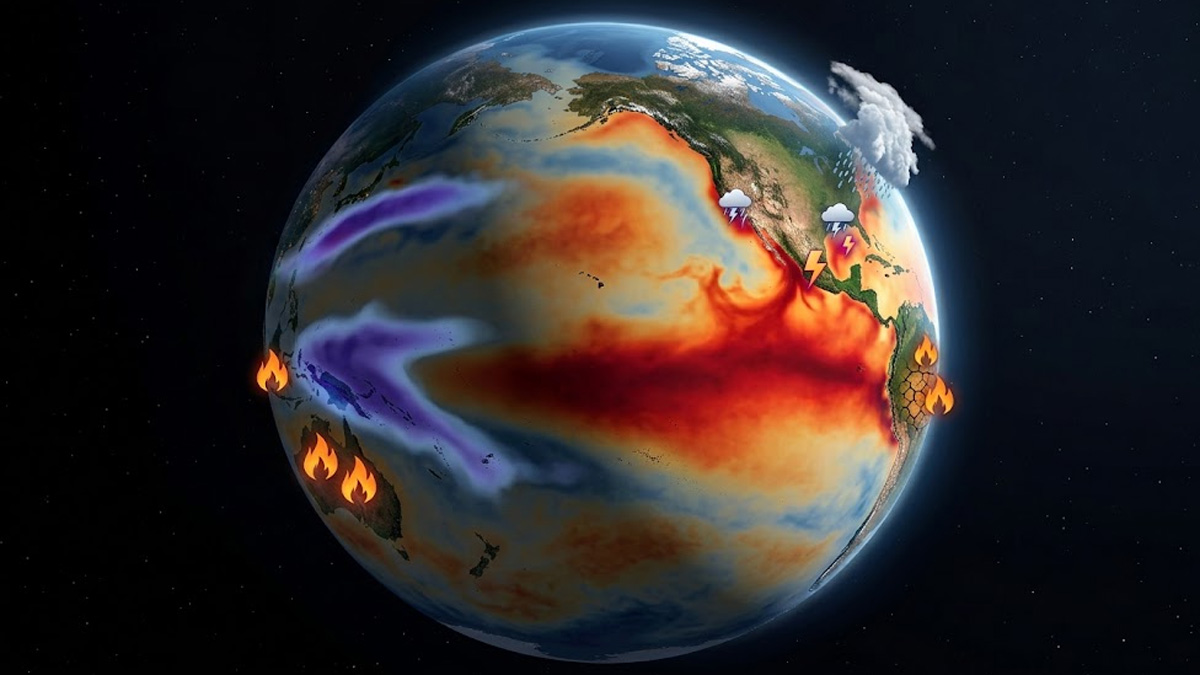
Scientists are closely monitoring the development of a potentially “super” El Niño, warning that the powerful climate phenomenon could drive record-breaking global temperatures and trigger widespread weather extremes across the world.
El Niño is one phase of the El Niño–Southern Oscillation (ENSO), a naturally occurring climate cycle that develops every two to seven years. It begins when sea-surface temperatures in the eastern equatorial Pacific Ocean become warmer than normal, altering atmospheric circulation and influencing weather patterns worldwide.
According to the U.S. National Oceanic and Atmospheric Administration (NOAA), El Niño conditions officially develop when ocean temperatures remain at least 0.5°C above average for several months. A super El Niño occurs when temperatures rise by more than 2°C above average, significantly increasing its global impacts.


Scientists warn that a strong El Niño transfers vast amounts of heat from the Pacific Ocean into the atmosphere, temporarily raising global temperatures. Forecasts suggest that if current warming continues, November and December could experience exceptionally high global temperatures, adding to the effects of long-term human-driven climate change.
The phenomenon can produce contrasting weather patterns across different regions. Some areas experience severe droughts and heatwaves, while others face intense rainfall, flooding and stronger storms. These changes can affect agriculture, water availability, public health and infrastructure. Higher temperatures may also increase the spread of mosquito-borne diseases such as malaria and dengue in vulnerable regions.
Previous super El Niño events have caused devastating impacts. The 1997–98 El Niño, considered one of the strongest on record, triggered catastrophic floods in Peru and East Africa, severe droughts and wildfires in Southeast Asia, widespread coral bleaching and billions of dollars in economic losses worldwide. Scientists caution that even a moderately strong event today could have greater consequences because it would occur alongside ongoing global warming.
Researchers are also exploring future strategies to reduce the intensity of El Niño. One proposed approach involves injecting tiny aerosol particles into the atmosphere over parts of the Pacific Ocean to brighten clouds and reflect more sunlight back into space. Computer simulations suggest the method could weaken future El Niño events if implemented early, but scientists stress that the technology remains experimental and requires extensive research to evaluate its effectiveness and potential risks.
While no intervention can influence the current event, researchers say improving forecasting and preparedness remains the best defence against the far-reaching impacts of a super El Niño.
Author