










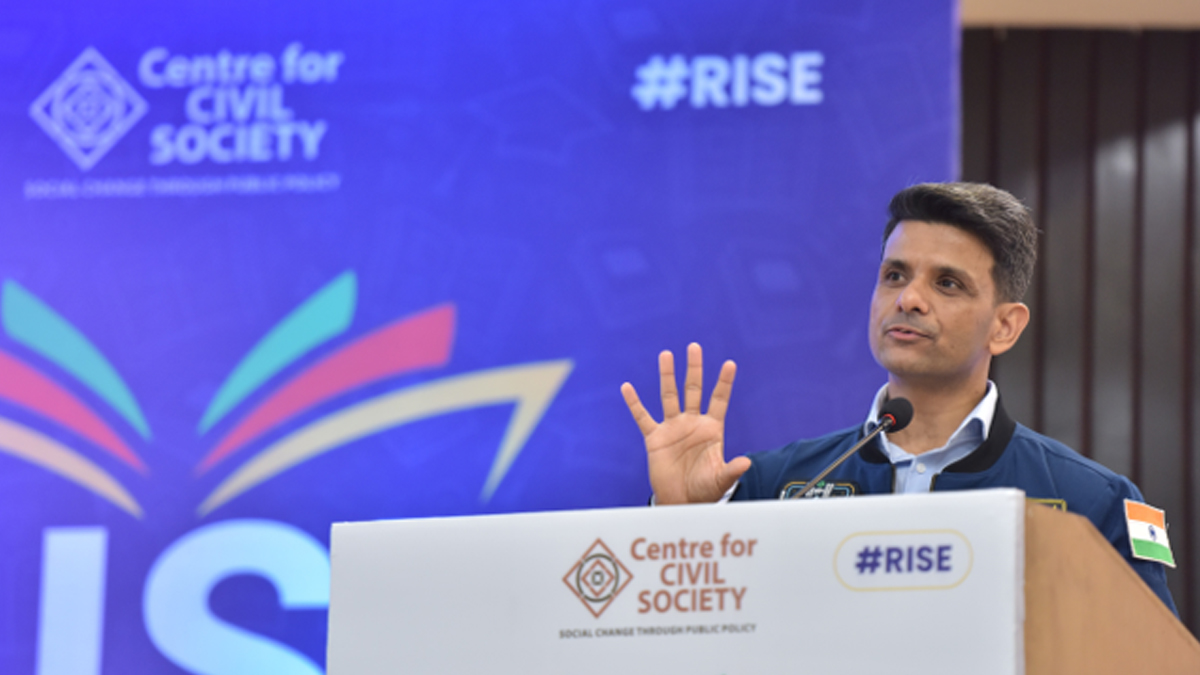
India’s first astronaut to visit the International Space Station, Shubhanshu Shukla, launched the Ease of Operating Schools (EoOS) Index 2026 at the Reforming India’s School Education (RISE) for Viksit Bharat conclave organised by Centre for Civil Society (CCS) at the India International Centre in New Delhi.
The EoOS Index is India’s first comprehensive assessment of the regulatory environment governing private schools across 28 states and two Union Territories. The report evaluates how laws, rules and regulations influence a school’s ability to establish, operate, expand, sustain itself and exercise institutional autonomy. The initiative aims to identify regulatory bottlenecks and encourage reforms that can improve the overall school education ecosystem in the country.
The launch was followed by a panel discussion on the future of school education reform in India, moderated by author and public intellectual Gurcharan Das. The discussion featured education leaders including Indrani Bhaduri, Shailendra Sharma, Taneya Singh, Vardan Kabra and Sunita Johar.


Panelists reflected on India’s educational journey since Independence and stressed the need for reforms to harness the country’s demographic dividend and support its aspiration of becoming a developed nation by 2047.
Addressing the gathering, Captain Shukla highlighted the importance of equipping children with problem-solving skills and the ability to navigate unfamiliar challenges. He described education as the single most important factor in determining whether India can achieve developed nation status by 2047.
Speaking at the event, CCS Chief Executive Officer Amit Chandra emphasised the urgency of investing in today’s students, noting that the human capital required for India’s future is currently sitting in classrooms across the country.
Gurcharan Das observed that while India has made progress in many sectors, educational outcomes remain a major concern. He said initiatives such as the Ease of Operating Schools Index could help attract more committed and innovative individuals into the education sector.
The conclave brought together policymakers, education leaders, researchers, school practitioners and civil society representatives to discuss reforms that can balance accountability, autonomy, innovation and quality learning opportunities for every child.
Author