














India’s electric vehicle (EV) industry is poised to generate between 30 million and 40 million jobs by 2030 as the country transitions towards clean mobility and domestic manufacturing, according to a report released by Adecco India. The report estimates that 10-15% of these jobs will be direct, while the remaining 85-90% will be created indirectly across manufacturing, infrastructure, battery technologies, recycling and allied sectors.
Adecco India said annual hiring in the EV sector is expected to grow by 15-20%, driven by rising adoption of electric passenger vehicles, commercial fleets, two-wheelers and public transport. The report notes that India’s EV ecosystem is projected to contribute nearly 60% of the country’s green jobs by the end of the decade.
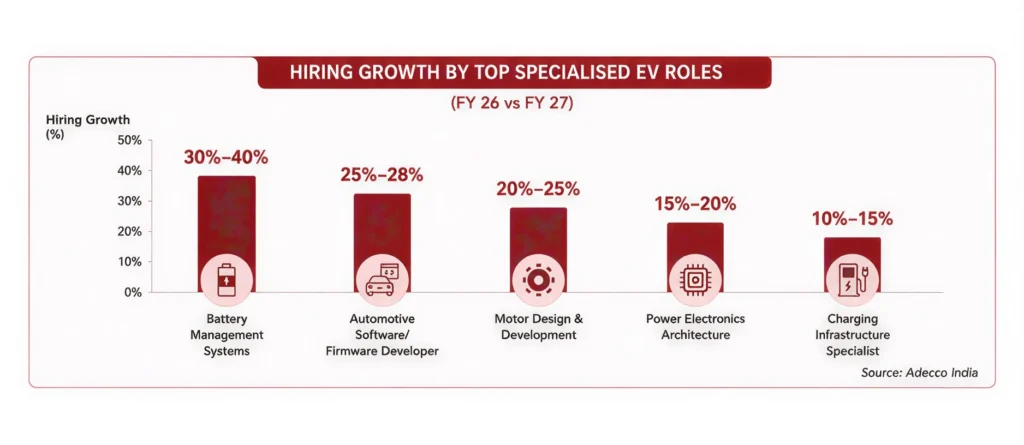
Specialised technical roles are expected to witness the strongest demand. Battery Management System (BMS) engineers could see hiring increase by 30-40%, while automotive software and firmware developers may record growth of 25-28%. Other high-demand roles include motor design engineers, power electronics specialists and charging infrastructure experts, with experienced professionals expected to command salaries ranging from ₹15 lakh to ₹38 lakh annually.
Manufacturing is projected to account for more than half of total employment demand, with established automotive hubs such as Tamil Nadu, Maharashtra, Gujarat, Karnataka, Telangana and the National Capital Region continuing to dominate recruitment. However, nearly 70% of new hiring mandates are expected to emerge from Tier-II and Tier-III industrial corridors, including Hosur, Sanand and Dholera, where investments in gigafactories, battery recycling units and EV component manufacturing are expanding rapidly.

Battery recycling is also emerging as a major employment driver. With battery waste expected to reach up to two million tonnes annually by 2030, the recycling industry could grow into a ₹31,150-crore market, supported by government incentives and international collaborations. Hiring in the segment is expected to increase by 25-30%, although the report highlights a significant shortage of skilled professionals.
Adecco India also cautioned that specialised talent availability continues to lag industry demand by 20-25%, particularly in battery sciences, electrochemistry, embedded software, power electronics and recycling engineering. The report stressed the need for large-scale reskilling of workers from conventional internal combustion engine (ICE) manufacturing, stronger industry-academia partnerships and greater investment in technical education to build a future-ready workforce.
Author