





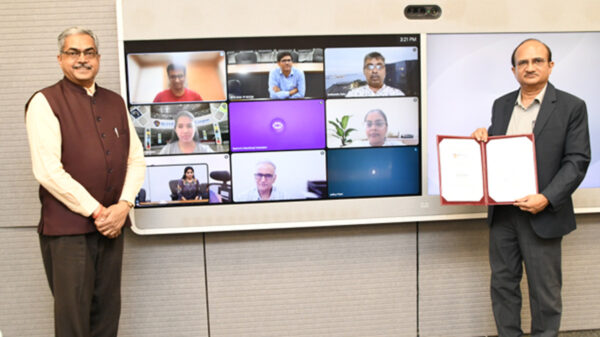







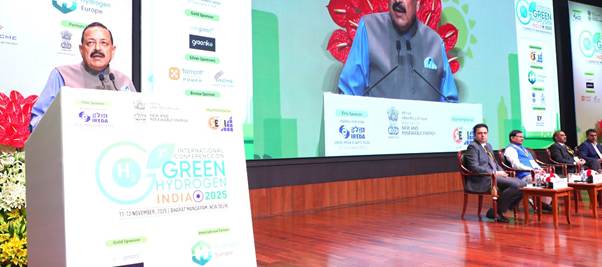
India has become a central player in the global shift toward a self-reliant hydrogen economy, Union Minister of State (Independent Charge) for Science and Technology Dr. Jitendra Singh said on Thursday while addressing the 3rd International Conference on Green Hydrogen (ICGH–2025) at Bharat Mandapam, New Delhi.
The Minister said clean energy is no longer just an environmental choice but an economic, technological, and strategic imperative for the country’s growth.
“India’s clean energy transformation is being driven by a collaborative model bringing together government, industry, and academia to build sustainable solutions for the future,” said Dr. Jitendra Singh. “India will not merely adopt clean technologies — we will invent them, lead them, and ignite the world with our vision and grit.”


Hydrogen Valleys to Demonstrate Full Value Chain
Highlighting key initiatives under the National Green Hydrogen Mission (NGHM), Dr. Singh announced the development of four Hydrogen Valleys across India with a total investment of ₹485 crore. Of this, ₹169.89 crore has been sanctioned under the NGHM, and ₹315.43 crore will come from industry and consortium partners.
These Hydrogen Valley Innovation Clusters (HVICs), conceptualized by the Department of Science and Technology (DST) and now integrated under the Ministry of New and Renewable Energy (MNRE), will demonstrate the complete hydrogen value chain — from production and storage to transport and utilization. The Minister said the clusters would serve as living laboratories for innovation, standardization, and policy development.
New RDI Scheme and Research Foundation to Accelerate Innovation
Dr. Singh also drew attention to the Research, Development and Innovation (RDI) Scheme, launched by Prime Minister Narendra Modi on November 3, describing it as a historic step to bridge discovery and deployment.
With a corpus of ₹1 lakh crore — including ₹20,000 crore earmarked for the DST — the scheme aims to strengthen deep-tech and clean energy innovation, with strong participation from startups and industry.
He said the scheme marks a shift from government-driven funding to a collaborative, sustainable model that promotes long-term scientific and economic resilience.
The Minister further cited the establishment of the Anusandhan National Research Foundation (ANRF) as a landmark reform to integrate academia, industry, and government under a mission-oriented research framework, aligning India’s scientific capabilities with national priorities such as clean energy and advanced manufacturing.
Driving Indigenous Innovation in EV and Hydrogen Technologies
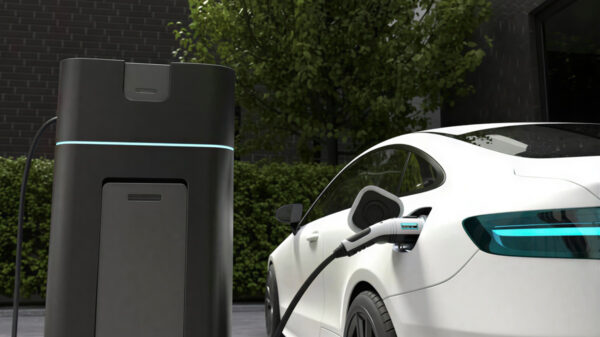
Citing the Mission for Advancement in High-Impact Areas – Electric Vehicle (MAHA–EV), Dr. Singh said the initiative reflects the Atmanirbhar Bharat vision by promoting indigenous innovation in electric mobility and hydrogen fuel technologies. The mission brings together public research institutions and private partners to develop advanced batteries, fuel cells, and scalable charging infrastructure suited to Indian conditions.
Global Collaboration Under Mission Innovation
Reaffirming India’s international leadership in clean energy, Dr. Singh noted that the term “Mission Innovation” was first coined by Prime Minister Modi. Under Mission Innovation 2.0, India is working with global partners to reduce the cost of clean hydrogen to USD 2 per kilogram and to replicate its Hydrogen Valley model worldwide by 2030.
“India’s leadership in this mission demonstrates how science, innovation, and enterprise are converging to power a clean and secure tomorrow,” Dr. Singh said.
The International Conference on Green Hydrogen (ICGH–2025) was organized by the Ministry of New and Renewable Energy (MNRE) and the Office of the Principal Scientific Adviser, in collaboration with the Ministry of Petroleum and Natural Gas (MoPNG), Department of Science and Technology (DST), and Department of Scientific and Industrial Research (DSIR).
Author