


















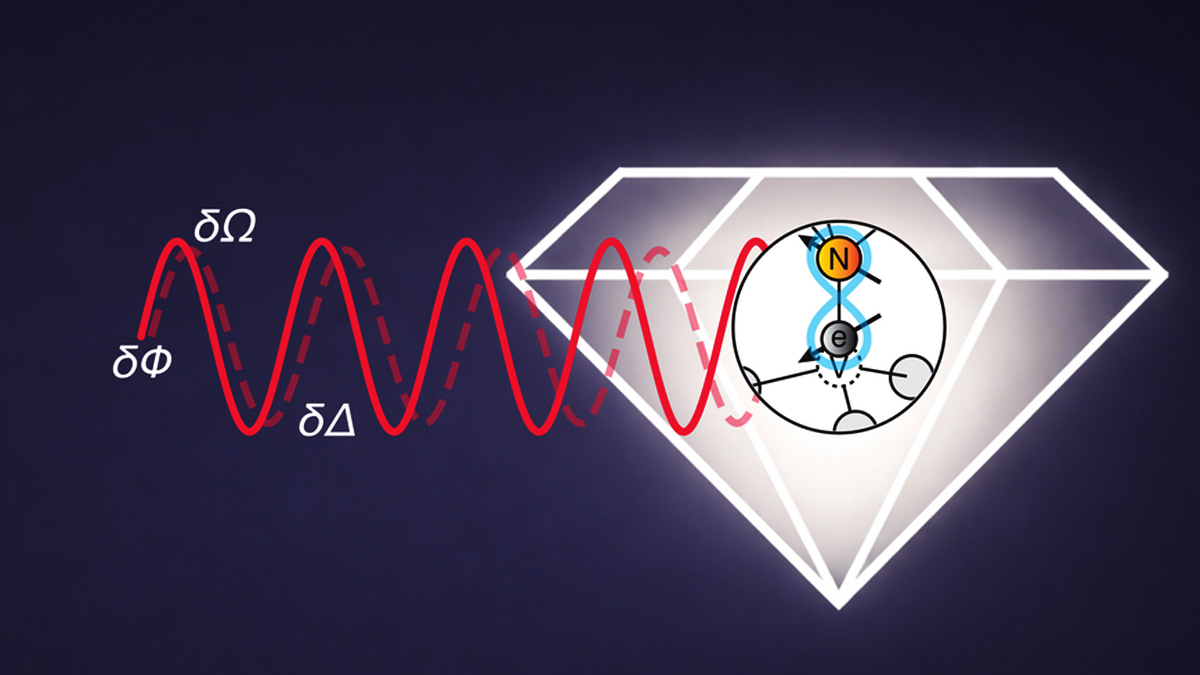
Researchers at Massachusetts Institute of Technology have developed a new method that allows quantum sensors to measure multiple physical properties simultaneously, overcoming a key limitation in existing systems. The study, published in PRX Quantum, demonstrates how entanglement can be used to extract several parameters—such as amplitude, frequency, and phase of a microwave field—in a single measurement.
Quantum sensors typically rely on effects like superposition and entanglement to detect extremely small signals. However, most solid-state quantum sensors have been limited to measuring one quantity at a time, as multiple signals tend to interfere with each other.
The MIT team addressed this by using two entangled qubits within nitrogen-vacancy (NV) centres in diamond, enabling simultaneous multi-parameter estimation. Importantly, the technique works at room temperature, making it suitable for real-world applications.

The approach could significantly enhance studies in biology and materials science, including probing cellular processes and understanding atomic-scale behaviour in materials. It also marks a step toward more practical quantum sensing systems capable of delivering richer, more efficient measurements in complex environments.
Author