















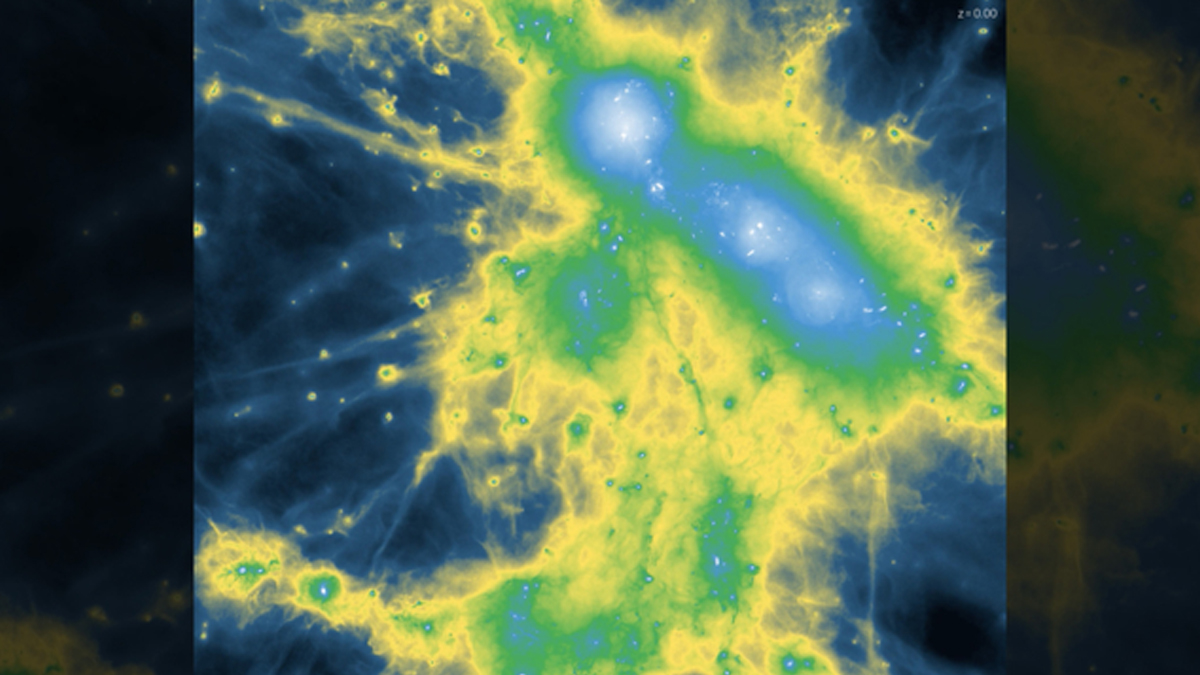
Scientists have uncovered a long-standing cosmic mystery by locating much of the universe’s “missing” ordinary matter in enormous, diffuse clouds surrounding galaxies. The breakthrough, led by researchers at the Massachusetts Institute of Technology (MIT) as part of the CHIME/FRB Collaboration, offers fresh insights into how galaxies evolve and interact with their surroundings.
Published in Physical Review Letters, the study introduces a novel method that combines observations of fast radio bursts (FRBs) with the positions of millions of galaxies to detect matter that has remained hidden for decades.
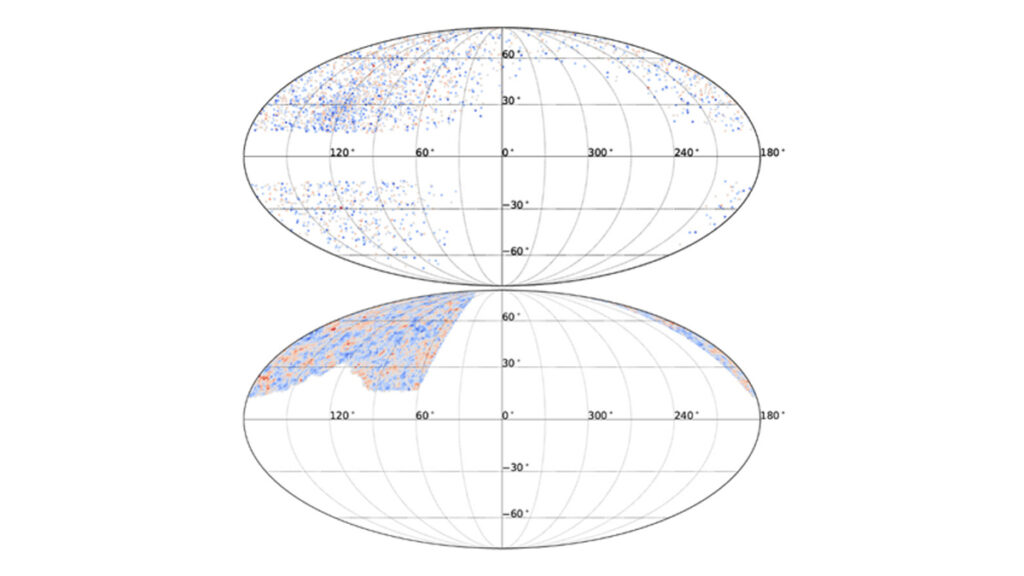
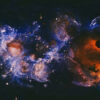
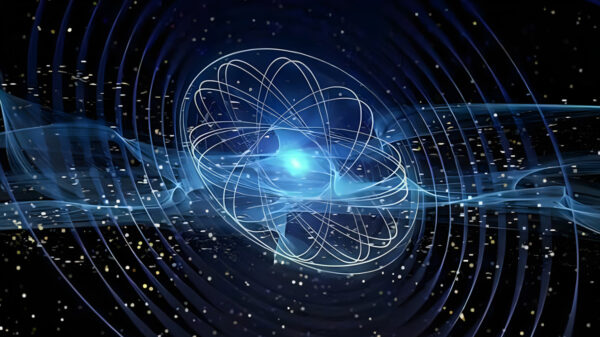
Credit: Haochen Wang
Although astronomers have accurately estimated the amount of ordinary, or baryonic, matter created after the Big Bang, only a fraction has been observed in stars, planets, and galaxies. The rest appeared to be missing.
To track it down, the researchers analysed 2,870 FRBs—brief but extremely bright flashes of radio waves originating from distant galaxies. As these signals travel across the universe, they are slightly delayed or “smeared” by the matter they pass through. By measuring this smearing and comparing it with the locations of more than six million galaxies mapped by the Dark Energy Spectroscopic Instrument (DESI), the team was able to determine where the unseen matter resides.

The findings reveal that the missing baryonic matter is not concentrated within galaxies but exists in vast, faint clouds extending nearly four million light-years beyond them—far larger than previous theoretical models had predicted.
“We’re finding missing matter that is pushed out to larger scales,” said Kiyoshi Masui, Associate Professor of Physics at MIT. “These measurements indicate that star activity and activity from black holes are stronger and much more violent than predicted.”
Lead author Haochen Wang, a graduate student at MIT’s Kavli Institute for Astrophysics and Space Research, said the results suggest galaxies behave more like “fountains,” ejecting gas over enormous distances through energetic processes such as black hole jets and exploding stars.
Beyond solving part of the universe’s missing matter puzzle, the study establishes fast radio bursts as a powerful new tool for mapping the invisible matter between galaxies. As the Canadian Hydrogen Intensity Mapping Experiment (CHIME) continues to detect thousands of additional FRBs, researchers expect the technique to provide even more detailed insights into the structure and evolution of the cosmos.
Author