






Rishav Raj, a first-year student at Lovely Professional University (LPU), has become the first analog astronaut from Jharkhand after serving as Mission Commander of the Lunar Analog Mission (LAM) 2026.
The 10-day mission was held from June 29 to July 8 at the PSA HAB, an analog space habitat developed by AAKA Space Studio in Dholavira, Gujarat. The site’s barren terrain was used to simulate conditions associated with lunar surface missions.
Leading a 200-hour simulated mission
Raj led a four-member international crew through more than 200 hours of continuous operations inside an isolated, resource-constrained habitat. As Mission Commander, he oversaw daily mission plans and Extra-Vehicular Activities (EVAs), managed limited power and water supplies, and had final authority over EVA approvals, emergency responses, safety escalations and medical evacuation decisions.

The mission also exposed the crew to habitat management, scientific experiments, robotics and decision-making under isolation.
Autonomous Rover Tested on Lunar-like Terrain
A key part of the mission was the development and field testing of an autonomous lunar rover led by Raj and his team. Built using the Robot Operating System (ROS) and Simultaneous Localization and Mapping (SLAM) technology, the rover autonomously navigated and mapped the rugged terrain in real time.
The trial demonstrated the use of autonomous navigation and mapping technologies in an environment designed to replicate some of the challenges of planetary exploration.
LPU Highlights Student Space Research
LPU said the mission reflects its efforts to give students practical exposure to robotics, artificial intelligence, aerospace technology and space research through its Department of Student Research & Project (DSRP).
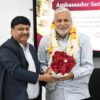
Congratulating Raj, Dr. Ashok Kumar Mittal, Member of Parliament (Rajya Sabha) and Founder Chancellor of LPU, said the achievement reflected the potential of young researchers to contribute to India’s growing space sector.The university said such initiatives are intended to provide students with hands-on experience relevant to future space exploration and planetary missions.
Author