
















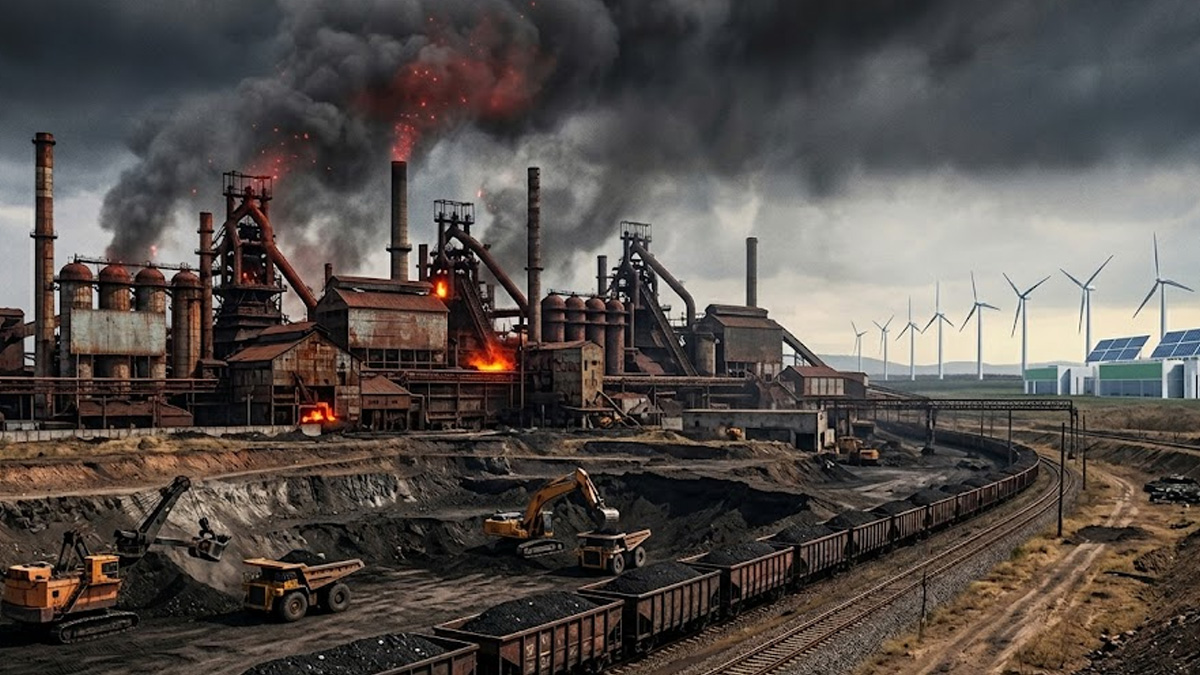
The global steel industry is continuing to invest heavily in coal-based production despite growing climate concerns, according to a new report released by Global Energy Monitor. The organisation’s sixth annual report warns that the rapid expansion of coal-dependent steelmaking could severely undermine the world’s transition towards cleaner industrial systems and net zero emissions.
The report, released on 11 May 2026, reveals that 319 million tonnes per annum (mtpa) of new coal-based blast furnace capacity has either been announced or is currently under construction worldwide. This marks a five percent increase compared to the previous year. Alongside this, another 80 mtpa of blast furnace capacity is set for “relining” a process that extends the life of existing furnaces rather than retiring them.
These new developments significantly outweigh the 141 mtpa of blast furnace capacity that currently has retirement plans. As a result, global blast furnace capacity is expected to grow by a net 88 mtpa by 2035.

The steel industry remains one of the world’s biggest industrial polluters. According to the report, nearly 88 percent of emissions from the sector come from coal-based production methods, while the industry itself contributes around 11 percent of total global carbon dioxide emissions.
Despite increasing international pressure to adopt greener technologies, progress remains slow. The report notes that electric arc furnace (EAF) steelmaking considered a lower-emissions alternative increased its share of global operating capacity by only one percent over the past year, rising from 33 percent to 34 percent.
Similarly, cleaner ironmaking technologies have seen minimal advancement. Only 10 percent of global ironmaking currently uses direct reduced iron (DRI), a lower-emission alternative to traditional coal-based blast furnace methods. More strikingly, only 2 percent, or approximately 4 mtpa, of operating DRI capacity uses green hydrogen as the main reducing agent instead of fossil fuels.
Astrid Grigsby-Schulte, Project Manager of the Global Iron and Steel Tracker at Global Energy Monitor, described the outlook as deeply concerning.
“The outlook remains bleak for steel’s transition away from fossil fuels. The ball is in India and China’s court, as the two countries plan 86% of new coal-based capacity,” she said.
She added that shifting towards lower-emission technologies and making better use of existing EAF facilities are two immediate steps that could significantly influence the future direction of the global steel industry.
India has emerged as the world’s largest developer of new coal-based blast furnace capacity, accounting for more than 60 percent of planned projects globally. The report further states that 93 percent of India’s ironmaking capacity currently under development will rely on coal-based technology.
However, the report also points to an opportunity for intervention. Only five percent of these proposed projects in India have actually begun construction, meaning policy shifts and investment changes could still alter the trajectory.
China, meanwhile, remains the second-largest net developer of blast furnace capacity after India. According to the findings, around 94 percent of China’s existing blast furnace capacity has no retirement plans in place, raising concerns about the country’s long-term dependence on coal-intensive steel production.
The report is based on data from the Global Iron and Steel Tracker (GIST), a comprehensive database that tracks crude iron and steel production plants worldwide. The tracker includes operational plants with a production capacity of at least 0.5 mtpa, as well as facilities proposed, under construction, retired, or mothballed since 2017.
Global Energy Monitor said its data is widely used by major international institutions including the Intergovernmental Panel on Climate Change (IPCC), the International Energy Agency (IEA), the United Nations Environment Programme (UNEP), the World Bank, and academic institutions such as the University of Oxford and Harvard University.
The findings come at a time when governments and industries across the globe are under pressure to decarbonise heavy industries. Experts argue that without a faster shift towards cleaner technologies, the steel sector could become one of the biggest obstacles to achieving international climate targets.
Author