












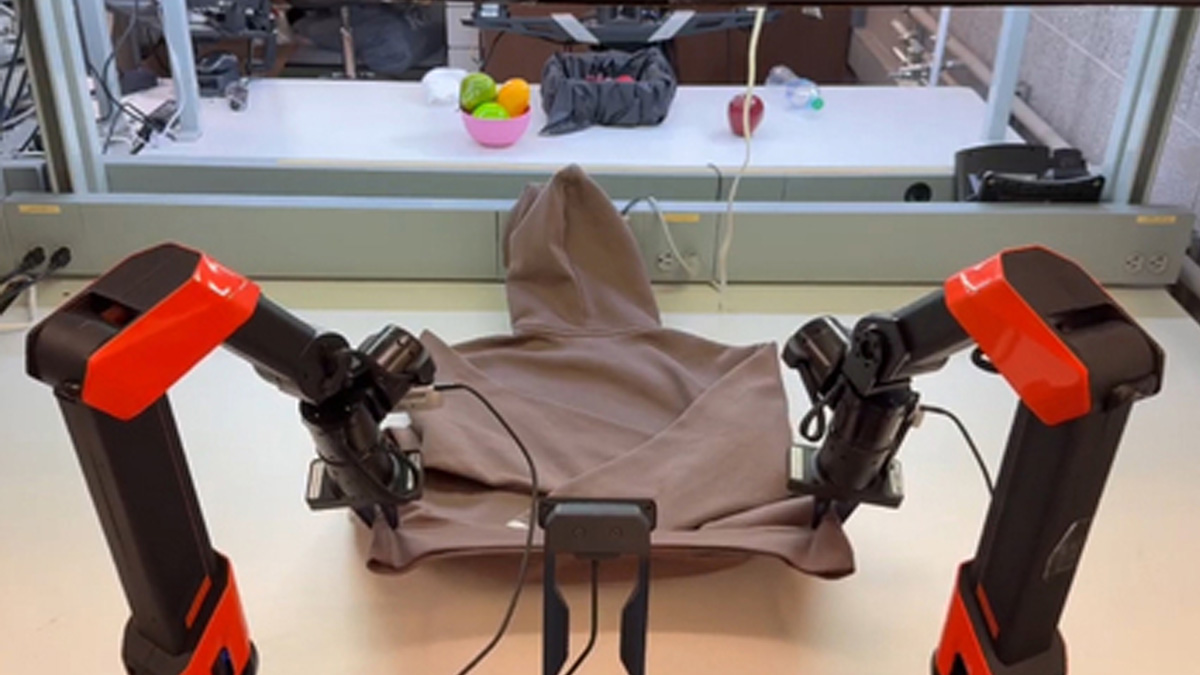
Researchers at the Massachusetts Institute of Technology (MIT) have developed a new artificial intelligence system that enables robots to anticipate their future movements while carrying out tasks, significantly improving their speed, efficiency and responsiveness. The technique, called Vision-Language-Action System with Hindsight (VLASH), allows robots to plan their next actions before completing their current ones, reducing delays and producing smoother, more natural movements.
The research addresses a common challenge in robotics, where robots often pause between actions while their AI systems calculate the next sequence of movements. These interruptions slow down performance and make it harder for robots to respond to dynamic environments.
VLASH overcomes this limitation by predicting the robot’s future position and using that information to prepare the next set of actions in advance. Rather than relying solely on the robot’s current state, the system forecasts where the robot will be after completing its ongoing task, allowing planning and execution to occur simultaneously without adding extra computational cost.

According to the researchers, the approach doubled the speed of robots performing routine tasks such as pick-and-place operations while reducing lag between movements. It also improved performance in fast-paced activities including table tennis and the arcade-style game Whack-a-Mole, where rapid decision-making and precise movements are essential.
The system was tested on both simulated environments and physical robotic hardware. In one demonstration, robots sorting coloured cubes into containers completed the task twice as fast as existing methods while maintaining approximately 90 per cent accuracy. Researchers also reported that the technology increased reaction speeds by more than 30 times compared to conventional approaches.
The team further enhanced the system using an “action quantisation” technique, enabling robots to execute larger movement sequences more efficiently. They also introduced a training method that helped AI models learn to use predicted future states, reducing training time fivefold without increasing computational requirements.
The research was led by Song Han, Associate Professor in MIT’s Department of Electrical Engineering and Computer Science, alongside graduate student Jiaming Tang, Tsinghua University student Yufei Sun and collaborators from NVIDIA, the University of California, Berkeley, the University of California, San Diego, and the California Institute of Technology (Caltech).
The researchers believe the technology could improve robots used in emergency response, search-and-rescue missions, manufacturing and other dynamic environments where quick reactions are critical. Future work will integrate VLASH with advanced AI “world models” capable of predicting changes in the surrounding environment, enabling robots to make even more intelligent real-time decisions.
Author