














Engineers at Massachusetts Institute of Technology have demonstrated that recycled plastic bottles could one day provide structural support for homes, offering a lighter and more sustainable alternative to traditional wood-based construction.
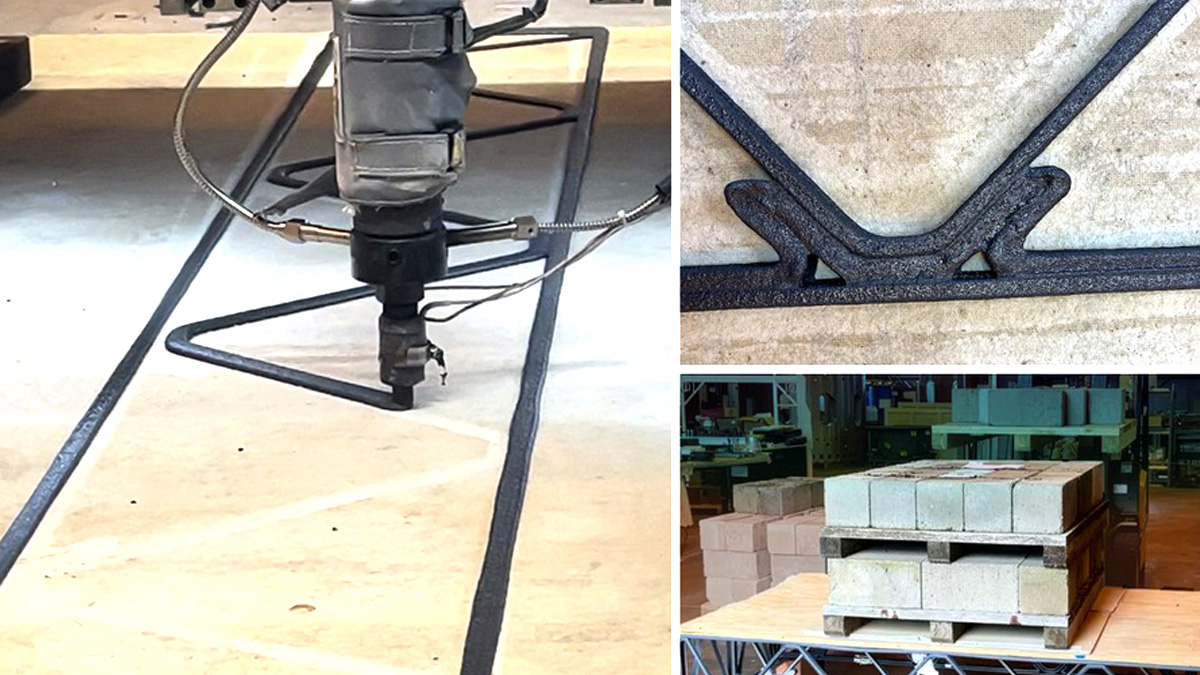
In a study published in the Solid FreeForm Fabrication Symposium Proceedings, the MIT team detailed the design and testing of 3D-printed floor trusses made from recycled plastic. These trusses, produced using large-scale additive manufacturing, were shown to meet — and in some cases exceed — key U.S. building standards for load-bearing capacity.
Traditional floor trusses are typically made from wood beams connected by metal plates in a ladder-like pattern with diagonal supports. The MIT researchers replicated and refined this design using recycled plastic, printing four trusses and assembling them into a conventional plywood-topped floor frame. During load testing, the structure supported more than 4,000 pounds, surpassing benchmarks set by the U.S. Department of Housing and Urban Development.

Each plastic truss weighed about 13 pounds, lighter than a comparable wooden truss, and could be printed in under 13 minutes using an industrial-scale 3D printer. The researchers are now working on printing additional structural elements, with the aim of assembling a full frame for a modest-sized home.
The work is being led by AJ Perez, lecturer in the MIT School of Engineering and research scientist in the MIT Office of Innovation, along with graduate students Tyler Godfrey, Kenan Sehnawi, Arjun Chandar, and David Hardt, professor of mechanical engineering. All are members of the MIT Laboratory for Manufacturing and Productivity.
The researchers argue that the approach could help address two converging global challenges: housing shortages and plastic waste. According to the team’s estimates, the world will need around one billion new homes by 2050. Meeting that demand with conventional timber construction would require unsustainable levels of deforestation.
“If we try to make that many homes using wood, we would need to clear-cut the equivalent of the Amazon rainforest three times over,” Perez said, adding that the goal is to recycle single-use plastics into building products that are “lighter, more durable, and sustainable.”
The project is part of MIT HAUS, a research group founded in 2019 within the Laboratory for Manufacturing and Productivity. Unlike most current experiments in 3D-printed housing, which focus on concrete or clay, MIT HAUS is exploring the use of recycled ‘dirty’ plastic — material that does not need to be extensively cleaned before reuse. The long-term vision is to shred used bottles and food containers, pelletise them, and feed them directly into large-scale printers to produce structural components such as floor trusses, wall studs, roof trusses, and stair stringers.
For the current study, the team used pellets made from recycled PET polymers combined with glass fibres to improve strength and printability. The printed trusses met existing U.S. building codes for stiffness, though researchers note that production costs must be reduced before the technology can compete commercially with wood.
Future experiments will test trusses made from lower-grade plastics, such as used soda bottles with residual contaminants, to understand how impurities affect performance. If successful, the researchers envision decentralised “micro-factories” located near sources of plastic waste, producing lightweight building components that can be easily transported to areas with urgent housing needs.
The study marks a step toward rethinking plastic waste not as an environmental burden, but as a potential structural resource for sustainable housing.
Author