


















In a significant step toward embedding climate consciousness within public education, the Tamil Nadu government has rolled out Climate Education and Cool Roof initiatives across 300 Green Schools, strengthening the state’s broader strategy to integrate sustainability into governance and infrastructure.
The programme was formally launched by Minister for Finance and Environment, Climate Change Thiru. Thangam Thennarasu and Minister for School Education Thiru. Anbil Mahesh Poyyamozhi, signalling high-level political backing for what officials describe as a long-term investment in climate resilience and youth leadership.
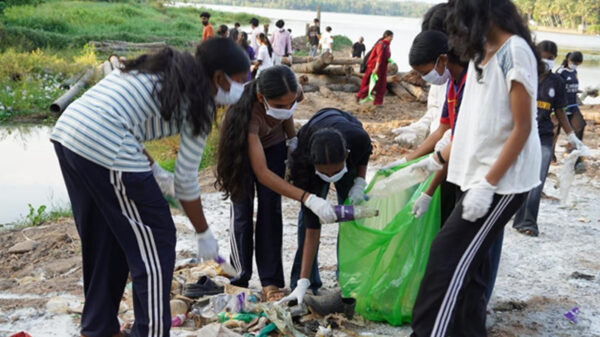
The initiative is anchored under the Tamil Nadu Climate Change Mission and seeks to institutionalise climate literacy across the school education system. Announced in the 2025–26 state budget, the programme reimagines school campuses as “living laboratories” where students learn about climate change, natural resource management and sustainability through practical engagement rather than textbook instruction alone.

Under the framework, students will participate in experiential learning models that connect theory with real-world environmental challenges. The initiative is being implemented in collaboration with the School Education Department and includes structured residential teacher training programmes, student nature camps, and the statewide Soozhal Arivom climate quiz, aimed at nurturing ecological awareness from an early age.
A central pillar of the programme is capacity building among educators. The government has launched a Training of Teachers (ToT) module on climate education alongside a newly inaugurated Certified Residential Training Programme for School Teachers. The ambitious target is to train 4,000 teachers across all 38 districts as volunteer climate ambassadors, with at least 50 per cent of participants drawn from government and government-aided schools.
The first phase of residential training, covering 210 teachers, is scheduled to begin in Salem on 20 January 2026.
Policy experts view the initiative as one of the more structured attempts in India to mainstream climate education at scale within public schooling. By linking infrastructure interventions such as cool roofs with curriculum innovation, the programme positions schools not just as learning spaces but as frontline institutions in the state’s climate adaptation strategy.
As climate risks intensify across South India—from extreme heat to water stress—the Tamil Nadu model could offer a template for other states seeking to combine education reform with climate action in a meaningful and measurable way.
Author