









The crescent moon emerges as a recurring motif in the works of sculptor Khageswar Rout, currently on display at the sixth edition of the Kochi-Muziris Biennale.
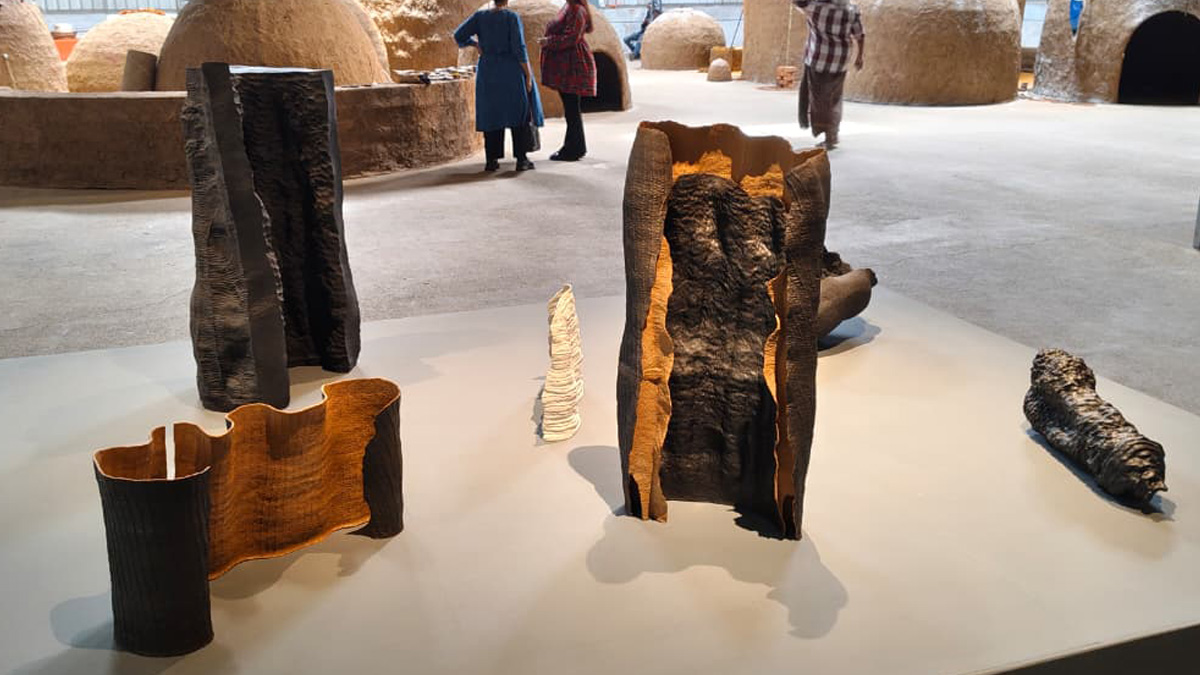
Through a series of hand-crafted sculptural installations, Rout examines the internal, external, and shadowed dimensions of life, using light as a central expressive element. His works are created entirely from natural materials, including clay, stone, and bark, and reflect an exploration of organic forms reimagined through sculptural practice.
The installation is exhibited at the Island Warehouse on Willingdon Island, one of the venues hosting the biennale across the port city. The crescent moon, repeatedly referenced in the works, functions as a symbolic device representing the duality of existence — the constant interplay between light and darkness, and the transitions between the two.
According to the artist, this symbolism reflects how illumination can dissolve into darkness and how darkness, in turn, can evolve into light. The sculptural forms seek to express this tension while drawing attention to the relationship between material, meaning, and perception.
Born in 1992 in Bhadrak, Odisha, Rout is currently based in Kolkata. His artistic practice focuses on examining the inner structures of plant forms through clay. He deliberately incorporates hollow spaces into his sculptures, drawing parallels between plant anatomy and architectural spaces.
Rout compares these voids to windows that allow a glimpse into inner worlds, likening them to the human mind, where surface and depth coexist. He suggests that growth and decay unfold simultaneously within the folds and fractures of plant life — a process that mirrors both physical and psychological existence.
While the works reference themes of climate crisis and ecological imbalance, they also emphasise the resilience of nature. Balance, Rout notes, remains a central concern in his sculptures, even when the forms appear fragile.
The installation presents a reflection on the interconnectedness of nature and humanity, highlighting equilibrium as a shared condition shaping both the natural world and human experience
Author